

"The old WordPress site got me nowhere. The new one ranks on Google and brings bookings in properly."
The Starting Point
A WordPress site with broken forms, no usable handoff, and no reliable route from online interest into booked appointments.
- Contact forms sent to an email the business could not access
- No clear handoff instructions or easy way to manage the site
- Online visitors had no reliable route into booking
- New patients were still coming mainly through sports team referrals
What Changed
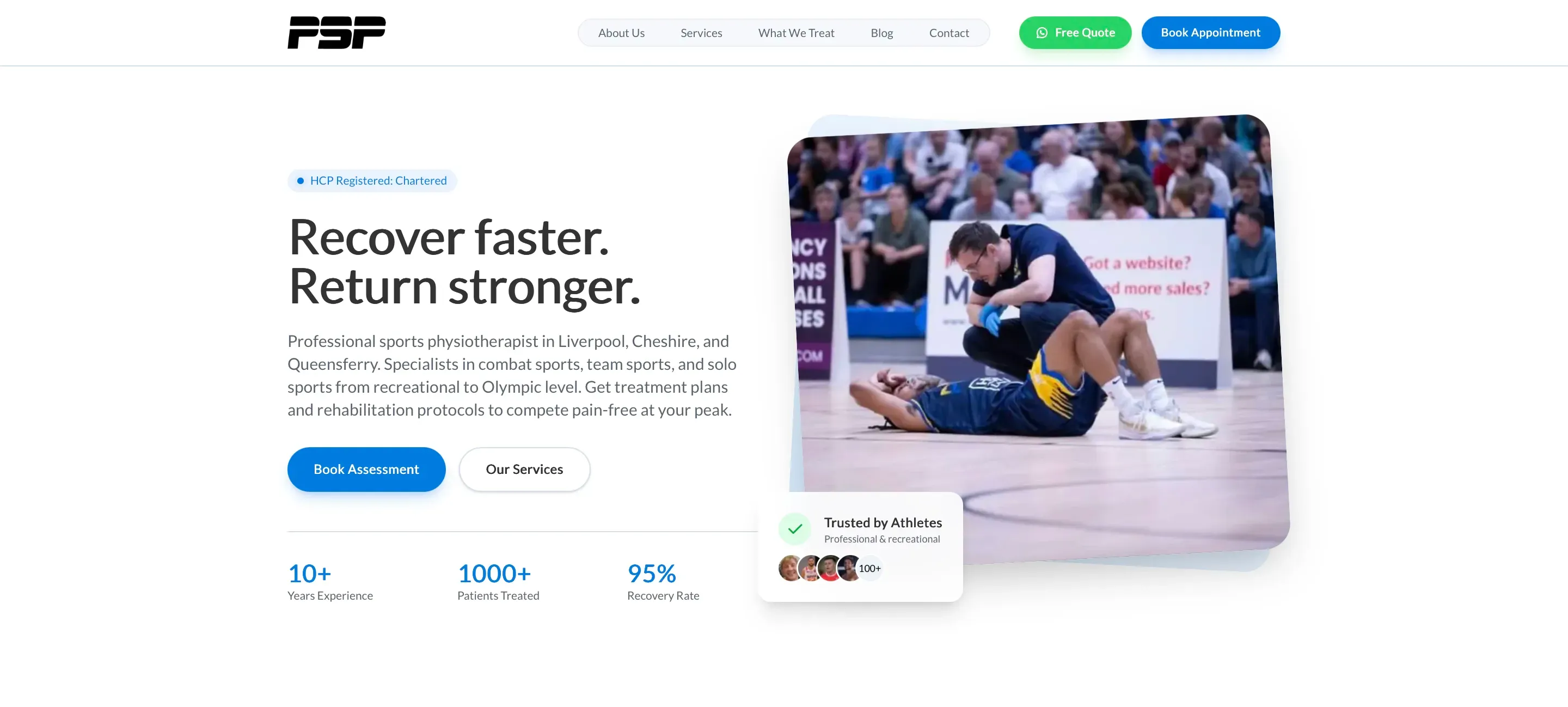
A fast, custom-coded site with integrated booking that ranks #1 for combat sports physio searches.
- Custom Astro site replacing the broken WordPress build
- Xanda booking integration (GDPR-compliant for healthcare)
- Google Business Profile management
- Monthly blog posts with medical citations
- SEO targeting combat sports and local searches
The Result
The site became a clearer route from Google and referrals into direct bookings.
- Ranked #1 on Google for the target combat sports physio search
- Created a direct booking path instead of back-and-forth DMs
- Made healthcare credentials and athlete proof easier to see before booking
- Gave the practice a platform that could keep improving with ongoing SEO content
Why change was needed
The old setup was costing trust before a patient ever booked
For a healthcare business, the website has to prove credibility and make the next step feel safe. A broken or vague site does the opposite.
Interested patients had no reliable route to book
Broken forms and unclear handoff meant online intent could disappear before it reached the practice.
Offline credibility was not obvious online
The practice had real experience and athlete proof, but the old site did not make those reasons to trust visible quickly enough.
Referral growth had no search foundation
Referrals mattered, but the business needed a way to be found by people already searching for a specialist sports physio.
What was rebuilt
The work mapped directly to the services a trust-led practice needs
This was not just a redesign. Each piece had to reduce doubt, improve visibility, or make booking easier.
Website rebuild
A faster custom site replaced the broken WordPress setup and gave the practice a more stable foundation.
Booking integration
Xanda was integrated so patients could move from interest to appointment without manual back and forth.
Trust proof
NHS experience, specialist positioning, athlete proof, and service context were brought into the decision path.
Local SEO
Pages and Google Business Profile work targeted the searches most likely to bring in relevant patients.
Healthcare content
Ongoing blog content uses cited medical sources so the site can support both search and patient trust.
The result
Search visibility turned into a clearer path to booked appointments
The strongest result was not only the ranking. It was the way the site connected credibility, local search intent, and a direct booking route.
The enquiry uplift is directional because the old setup had little reliable baseline tracking. The useful comparison is the shift from a broken, referral-heavy website to a site that can be found, trusted, and booked through.
Why it worked
The repeatable parts of this project
The industry changes, but the buyer logic is the same: people need proof, clarity, and a next step that feels easy to take.
Specific positioning beats a generic service page
Combat sports physio is easier to understand and rank for than a vague physiotherapy offer aimed at everyone.
Proof needs to show up before doubt builds
Credentials, athlete experience, and specialist context were placed where visitors are deciding whether to trust the practice.
Booking should match buyer intent
If someone is ready to book, the site should not force them back into DMs, forms, or waiting for a reply.
Search works faster when the niche is clear
Focused service pages, local context, and Google Business Profile support gave the site a clearer path into relevant searches.
Client story
Behind the work
The details below give useful context, but the commercial lesson is simple: credibility needs a system around it.
From referral-led to search-ready
Connor had moved into private practice with a clear specialism: sports physiotherapy for combat sports athletes, team sport players, and active people who needed proper treatment rather than generic advice.
He had already built trust offline through local basketball teams and combat sports athletes. But the website was not supporting that reputation. It was not giving new visitors a clear reason to trust the practice, understand the services, or book without extra back and forth.
The project started with a practical question: could the existing WordPress site be fixed, or would it be cleaner to rebuild?
After reviewing the structure, plugins, handoff problems, and booking flow, the rebuild was the better route. The old site was not just visually weak. It was not doing the commercial job of helping patients move from search or referral into a booked appointment.
Healthcare-specific decisions
Physio websites have a different trust burden from many local service sites. Medical credibility matters, claims need care, and the visitor needs to feel they are choosing someone qualified rather than just someone nearby.
That shaped the structure. NHS experience, specialist sports positioning, and work with athletes all needed to be visible. The service pages had to be clear enough for a patient to understand what they were booking, and the blog content needed to use medical references so it could support authority instead of sounding thin.
Booking and local visibility
Xanda became the booking layer because it already handles physiotherapy-specific needs: patient intake forms, appointment scheduling, deposits, and GDPR-aware workflows.
That matters because the website should not stop at convincing someone. It should help them act while the intent is high.
Google Business Profile work supported the website too. Reviews, local context, and service clarity all work together when someone is comparing healthcare providers.
Credibility compounds
The practice already had strong proof, including work with combat sports athletes and professional team sport.
That proof matters more when it is easy to see. A stronger website turns offline credibility into online confidence, and that gives search traffic and referrals a better chance of becoming real appointments.
Ongoing work
The site continues to improve through regular updates, Google Business Profile management, and ongoing blog content.
The project also supported the wider presentation of the practice:
- Marketing materials - Posters for when he worked from a climbing gym, signage for his home clinic
- Clinic plaque - The logo and branding for his garage-converted treatment room
- Platform selection - We tried several booking systems before landing on Xanda
Those supporting pieces matter because a service business does not only need a website that looks good in isolation. It needs the online journey, booking tools, local presence, and offline touchpoints to feel like the same credible business.
Is this relevant to you?
This approach is a fit if your expertise is stronger than your current website makes it look
The same structure applies to service businesses where trust has to be earned before someone enquires or books.
You already get referrals, but search does not bring enough of the right people
Your site does not clearly show why someone should trust you
Your booking or enquiry path still relies on manual back and forth
You need service pages that explain the offer before a conversation

Request a Free Website Preview
If you're a physio or therapist relying on referrals, this SEO-first approach works. The same strategy that got Professional Sports Physio to #1 on Google can work for your practice in your area.